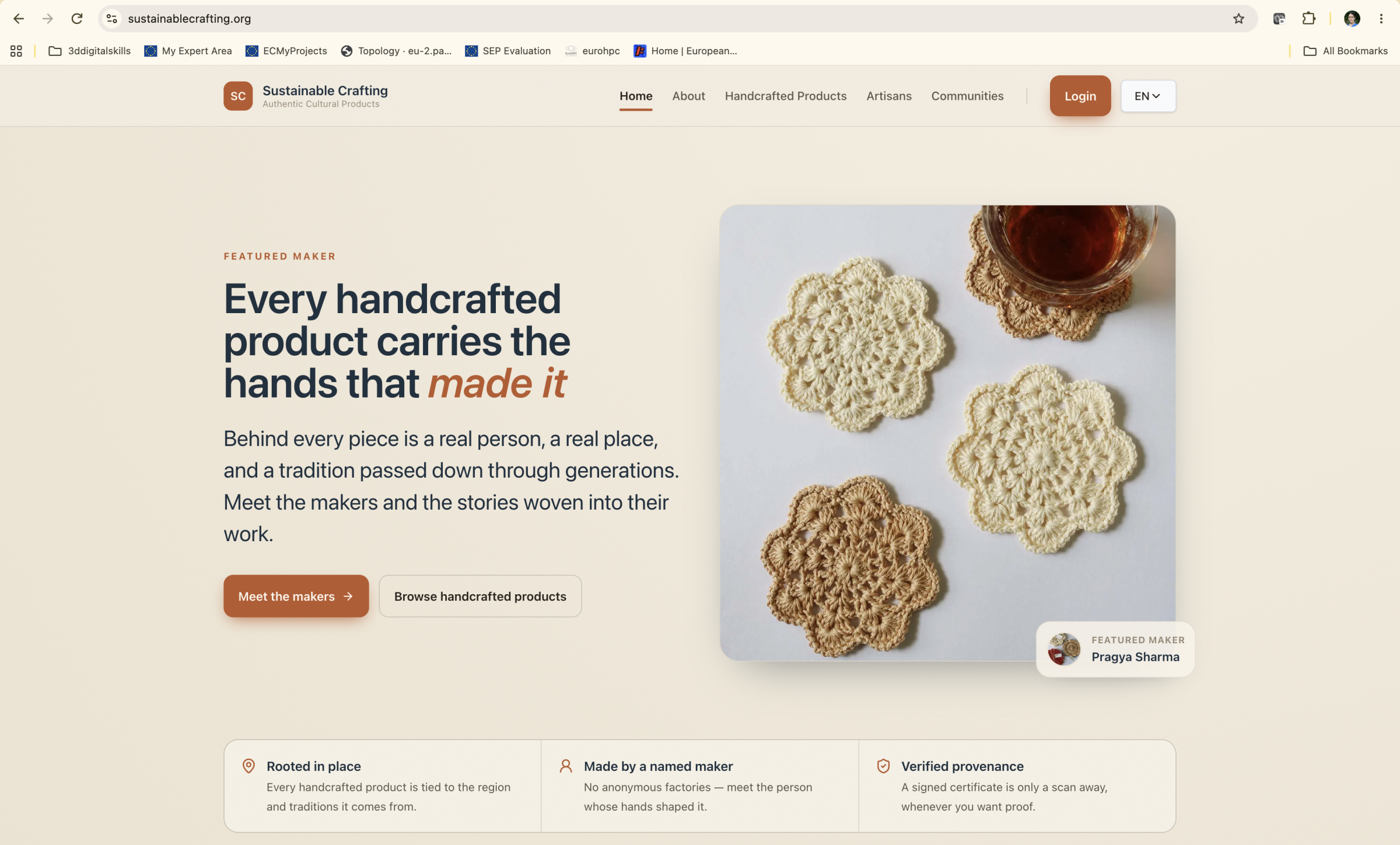
We are pleased to announce the launch of SustainableCrafting. This artisan-centred digital platform enables artisans worldwide to document their handmade products, connect, and support their socioeconomic activities, while communicating their authenticity and cultural and economic value.
For many communities, the continuation of craft depends not only on preserving knowledge. It also depends on visibility, recognition, and economic sustainability to address growing challenges such as generational disconnection, skill loss, lack of recognition, and limited market access. The project identified a gap in digital technologies for heritage crafts. Many digital platforms focus on documenting knowledge from craft communities as heritage bearers, while other commercial platforms focus on selling products. As a result, provenance, knowledge ownership and artisans’ control over how their craft is represented for commercial purposes remain insufficiently addressed. Sustainable Crafting is designed to address this gap.
An artisan-centred platform
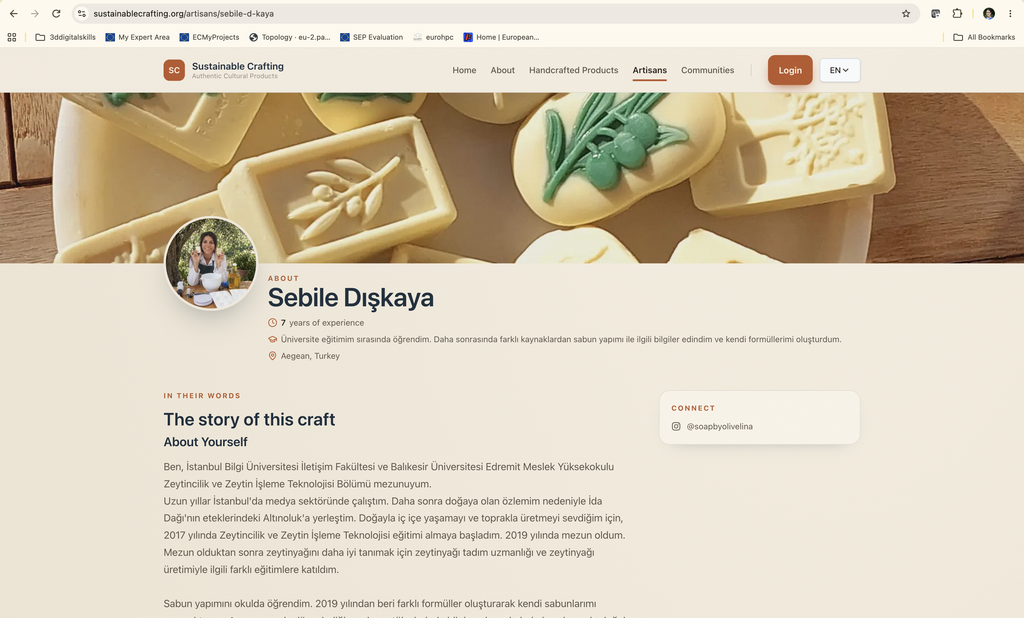
SustainableCrafting foregrounds artisans’ agency and participation in decisions about documenting, representing, accessing, and reusing their knowledge, identities, and practices. The platform supports artisans to share who they are, the materials, tools and processes they use, the places in which their craft is made, and the meanings it carries. In doing so, it recognises local knowledge as central to heritage interpretation, positioning artisans as the primary voices of their craft rather than subjects of documentation by others.
Provenance and value
Sustainable Crafting highlights aspects of making that underpin craft as a living form of intangible cultural heritage, including skills, tacit knowledge, materials, places, and the cultural histories behind the creative process. By connecting artisans’ accounts of their craft with provenance and market-facing communication, Sustainable Crafting aims to increase the visibility and perceived value of handmade work while supporting cultural continuity and economic resilience. Ultimately, heritage fluency becomes creative capital, positioning communities to benefit where authenticity, provenance and cultural storytelling are increasingly valued worldwide.
Co-designing the Sustainable Crafting Platform
The Sustainable Crafting platform was developed through an iterative, interdisciplinary co-design process that combines artisan-centred inquiry, design, and technical implementation. Through various activities, including workshops with artisans in India and across broader geographical regions, the project co-developed requirements, ensuring design decisions respond to their practices, capacities, and concerns, and support their needs. Insights from workshops were translated into design requirements for the platform. Artisans needed a simple way to introduce themselves, document their materials and processes, and connect individual products to their wider cultural and personal contexts. They also needed flexibility to decide what to share, how to express it, and what to keep private.
The research was also supported by PhD student Nasim Dadizadeh at the University of Trento and University of Brighton student Mario Boykovski. The Friedrich-Alexander-Universität Erlangen-Nürnberg (FAU) provides the infrastructure, supported by Frank Bauer and Prof. Tim Weyrich.
Community-owned infrastructure
Co-design extends to the platform’s infrastructure. Sustainable Crafting releases its software as open source under the Apache License, Version 2.0, and provides it as community-owned infrastructure. Communities and organisations can deploy and manage their own instances, enhancing their control and agency over their data and stories. The application is built with Next.js (React), using shadcn/ui components based on Radix primitives and styled with Tailwind CSS (v3). Data is managed through the Prisma ORM with a PostgreSQL database, configured via environment variables for both development and production. The complete stack is containerised with Docker for straightforward deployment.
The code is available at: https://github.com/culturedigitalskills/craft-authentication
Next steps
Co-designing the digital platform and onboarding users is an ongoing process. Next stages will include pilot testing with artisans, digital skills training, practical support for preparing materials, and evaluation with different user groups. Their feedback will continue to shape the platform, creating cultural, social, and economic value alongside craft communities.
Get involved
The platform will continue to be developed through ongoing engagement with artisans and user communities. We invite artisans, makers and digital innovators to join the platform and share their craft. We particularly welcome researchers, heritage organisations and craft networks interested in collaborating or supporting its development and communication.
Visit the platform at www.sustainablecrafting.org.